
Postpartum Mental Health: What Every Parent Should Know

The Realities of Postpartum Adjustment and What to Expect (From a Perinatal Therapist)

Meeting your Baby: “Love at first sight” is not a universal experience when meeting your baby. Your body has just gone through a major physical and hormonal transition, and it can take time for the nervous system and emotional connection to settle. Attachment often builds gradually through repeated care, contact, and getting to know your baby. Give yourself permission for that bond to unfold over time.
Hormones: Estrogen and progesterone drop dramatically within hours after birth. This sudden and rapid hormonal withdrawal, combined with shifts in oxytocin, prolactin, stress hormones, and severe sleep deprivation, creates a rapid neurobiological experience that can significantly affect mood, emotional regulation, and sensitivity in the early postpartum period. Understandably, this can feel like a roller coaster of emotions.
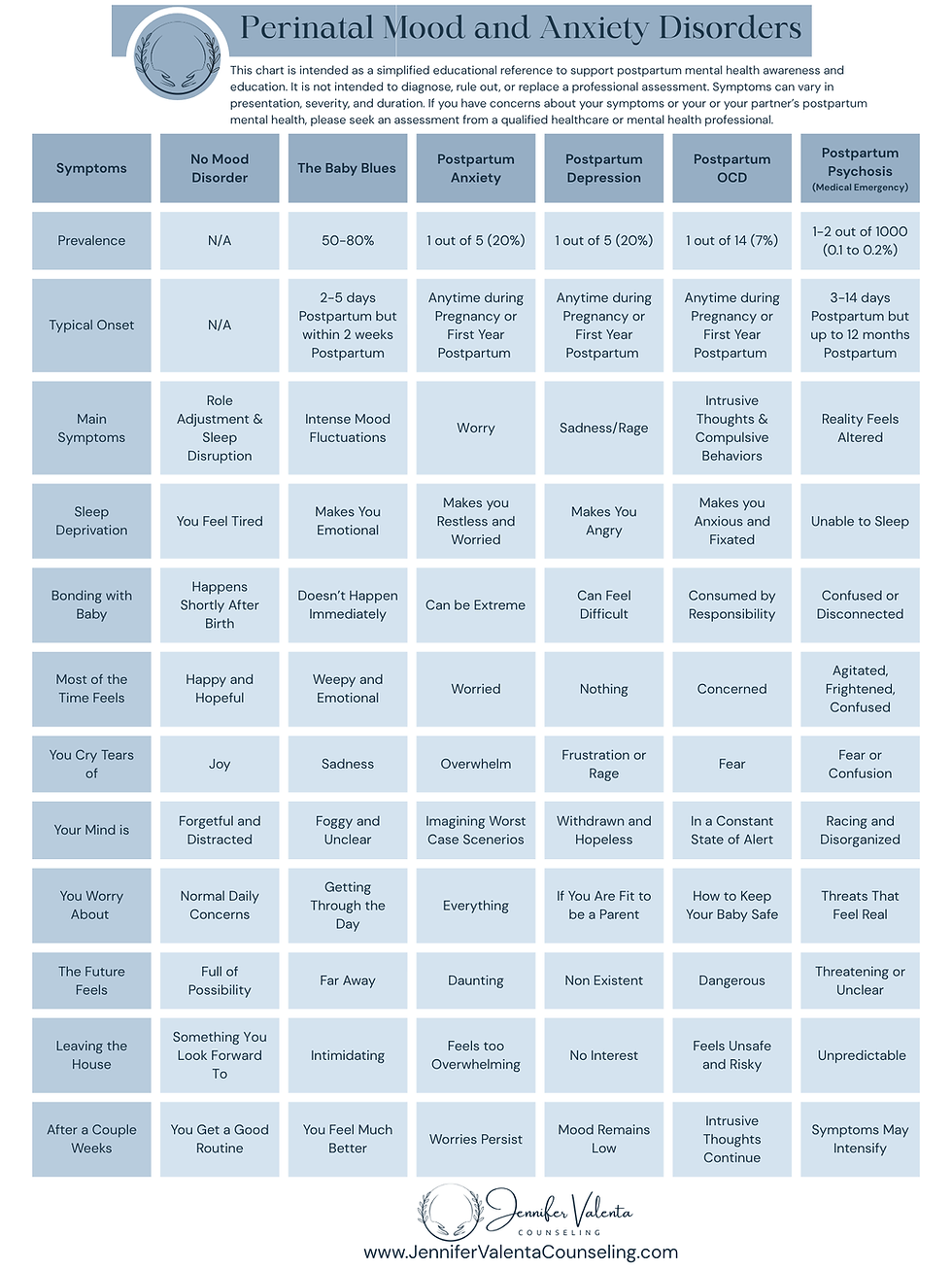
Baby Blues: “Baby blues” is a common, temporary emotional shift that many people experience in the first days to about two weeks after giving birth. It is usually caused by rapid hormonal changes after delivery (especially drops in estrogen and progesterone), combined with physical recovery, sleep deprivation, and the emotional intensity of caring for a newborn. Symptoms can include mood swings, crying more easily, irritability, feeling overwhelmed, anxiety, or difficulty sleeping. The “baby blues” often hit hardest around days 3–5 postpartum. If you still feel off after two weeks, it may be more than “just hormones.”
Postpartum Timeline: Postpartum does not end at 6 weeks. Adjustment, healing, identity shifts, and mental health challenges can continue for months or years.
Matrescence: Matrescence is the term used to describe the profound physical, emotional, hormonal, and identity shift that occurs when someone becomes a mother. It is often compared to adolescence because it is a major developmental transition that can involve changes in mood, sense of self, relationships, and brain and body functioning.This process is not just psychological but biological as well, shaped by pregnancy, birth, sleep disruption, and ongoing caregiving demands. Experiencing emotional intensity, uncertainty, or identity confusion during this time is a normal part of this transition rather than a sign that something is wrong.
“Mom Brain”: “Mom brain” refers to the cognitive changes many people notice during pregnancy and the postpartum period, such as forgetfulness, difficulty concentrating, or feeling mentally slower. Research suggests this is linked to real brain changes, including hormonal shifts, sleep deprivation, and neural adaptations that prioritize bonding, emotional attunement, and responding to a baby’s needs. Rather than a loss of ability, it reflects a brain temporarily reorganizing its resources during a major life transition.
Hearing your baby cry: Hearing your baby cry can feel physically and emotionally activating. Many parents experience a rush of anxiety, tension, urgency, or even physical discomfort when hearing their baby cry or being separated from them. There is real biology behind this! During pregnancy and postpartum, hormonal and nervous system changes increase attunement to your baby’s cues and activate caregiving responses. It is also completely normal if you do not experience this intensely. Bonding and attachment can look different from person to person, and there is no single “correct” emotional response to being a parent.
Perinatal Mood/Anxiety Disorders: About 1 in 5 birthing parents experience a perinatal mood or anxiety disorder. Postpartum depression is not always sadness. Symptoms can look like panic, numbness, rage, irritability, anxiety, disconnection, or complete exhaustion. Postpartum Mood/Anxiety disorders can develop anytime in the postpartum period, not just directly following birth. New or prolonged mood and anxiety symptoms should be professionally evaluated and supported.
Dads and Non Birthing Partners: Around 1 in 10 fathers and non-birthing partners experience postpartum depression or anxiety symptoms. Yes, Dad’s can be affected too!
Sleep: Sleep is one of the biggest protective factors for postpartum mental health. Rest is not a luxury, it is essential care. Focus on rest and healing first. The laundry, dishes, texts, and expectations can wait. You deserve time to recover physically, emotionally, and mentally.
Feeding your Baby: Breastfeeding is hard even when it’s going “well.” You are allowed to combo feed, supplement, pump, stop, or choose what works best for your family. There are many options for feeding your baby.
Scary Thoughts: Intrusive thoughts (or images) are unwanted thoughts that feel distressing, alarming, or "not like you". They do not mean you want to act on them or that you are a dangerous or a bad parent. They are common in the postpartum period and often happen when the brain is stuck in high-alert mode and constantly scanning for threat. This is coming from a protective part of your brain that wants to keep your baby safe.
Suicidal Ideation: In contrast, thoughts that feel consistent with your intent, feel justified, or come with a sense of desire or planning are different and require immediate support. If you are experiencing suicidal thoughts or thoughts of harming yourself or your baby that are aligned with how you are feeling, believable, or consistent with your current emotional state, it is important to reach out for support right away. These thoughts do not define your worth as a parent or person, but they do signal that you deserve immediate care and support.
You can contact a perinatal-trained therapist, your OB/GYN, go to your local emergency department, call 911 if you are in immediate danger, or reach out to Postpartum Support International for help at 1-800-944-4773.
SSRIs: Medication is not a failure. It is one of many tools that can help you feel more like yourself during a deeply difficult time. You do not have to suffer unnecessarily. Many SSRIs have a strong evidence base for safety in pregnancy and lactation, and the risks of untreated depression are often greater than the medication-related risks when symptoms are significant. It is also important to know that these medications typically take about 4–6 weeks to reach their full effect, so improvement may happen gradually over time.
Postpartum Guests: You are excited, and everyone else may be excited too, but you do not have to accommodate visitors or host anyone if you do not want to. Your job in the postpartum period is to rest, recover, and bond with your baby, not to entertain others. It is okay to say no, postpone visits, or set boundaries that protect your energy, healing, and wellbeing.
Your Body: “Bounce back” culture is a myth that ignores the reality of what pregnancy, birth, and postpartum do to the body and nervous system, and how different each person’s recovery and body changes can be. Every body responds differently, and changes in strength, shape, energy, and regulation vary widely and are influenced by many factors, not timelines or expectations. It is okay to move slowly, rest, and honor your body in ways that feel aligned with your values rather than external expectations.
Social Media: Social media can make it feel like there is one “right” way to parent, but what works best is what supports your baby, your values, and your family’s wellbeing. Pay attention to the qualifications of the people giving advice online, and notice how certain accounts make you feel. If content leaves you feeling anxious, inadequate, guilty, or overwhelmed, it is okay to unfollow, mute, or take a break. Curate your timeline to feel supportive, informative, and compassionate
Sleep Regressions: If you google “sleep regression” at any age, you will always find results. Baby and toddler sleep is constantly changing, developing, and fluctuating. It is not a linear path or a parenting failure. Sleep fluctuations are completely normal.
Sleeping through the night: Some babies do not sleep through the night at 6 months, 1 year, or even beyond toddlerhood. Shifting the focus from “fixing” your baby’s sleep to supporting your own rest, regulation, and capacity can be far more helpful than endlessly chasing sleep strategies that leave you feeling defeated.
Support: Get support from a perinatal-trained therapist, pelvic floor therapist, lactation specialist, OBGYN, perinatal-trained medication provider, childcare support, meal trains, or friends who can simply sit with you. None of these are signs of failure. You were never meant to do this alone.
Most importantly, you are exactly what your baby needs and you are doing better than you think you are!
If you are in immediate danger, call 911. For additional support, you can contact Postpartum Support International at 1-800-944-4773 or visit https://postpartum.net/.
Click below to schedule with a Jennifer Valenta Counseling for Specialized Mental Health Care to support Mood, Reproductive Health, Infertility, Pregnancy, and Postpartum experiences.
Comments